

Every painting operation relies on clean air to achieve flawless finishes and protect workers. Facility managers across European and North American sites face the constant challenge of controlling airborne contaminants and minimizing paint defects in busy spray booths. By understanding the fundamentals of spray booth air quality—including airflow styles, filtration technologies, and regulatory standards—you can make more informed choices that improve both performance and compliance. Effective air quality management is the foundation for consistent results and safer working conditions.
Table of Contents
- Spray Booth Air Quality Fundamentals
- Types Of Spray Booths And Airflow Systems
- How Contamination Impacts Finish Quality
- Air Filtration And Dust Control Technologies
- Health, Safety, And Compliance Obligations
- Avoiding Costly Mistakes In Spray Booth Air Management
Key Takeaways
| Point | Details |
|---|---|
| Air Quality Management | Effective air quality management can significantly enhance finish quality and reduce defects by up to 73%. Regular monitoring and proactive filtration replacement are crucial. |
| Spray Booth Design | Choosing the right airflow system is essential; downdraft systems offer superior contamination control, while crossdraft systems are more economical. |
| Contamination Sources | Understanding and mitigating contamination sources is vital, as they can degrade finish quality by up to 65%. Regular cleaning protocols and high-efficiency filters are recommended. |
| Compliance and Safety | Adherence to health and safety regulations is imperative to reduce workplace incidents by up to 78% and to ensure compliance with legal requirements. Conducting regular audits can facilitate ongoing safety measures. |
Spray booth air quality fundamentals
Air quality represents the critical foundation of successful painting operations within industrial and automotive spray booths. Maintaining pristine atmospheric conditions directly impacts finish quality, worker safety, and operational efficiency. Proper ventilation standards determine the effectiveness of contamination control and paint application processes.
Several fundamental elements define optimal spray booth air quality management:
- Airflow velocity controlling particle movement
- Filtration efficiency removing microscopic contaminants
- Air exchange rates preventing vapor and particulate buildup
- Pressure differential maintaining controlled environmental conditions
Most industrial spray environments require sophisticated air management systems that address multiple complex variables. These systems must simultaneously protect workers, prevent contamination, and create ideal painting conditions. The intake and exhaust mechanisms play crucial roles in maintaining consistent air quality standards.
Effective air quality management reduces paint defects by up to 73% and improves overall finishing performance.
Key considerations for spray booth air quality include preventing external dust infiltration, managing temperature and humidity, and ensuring consistent airflow patterns. Sophisticated filtration technologies utilize multi-stage approaches to trap particles ranging from large debris to microscopic contaminants.
Pro tip: Implement regular air quality monitoring protocols and replace filtration systems proactively to maintain optimal spray booth performance.
Types of spray booths and airflow systems
Spray booth design directly impacts painting quality, with three primary airflow systems defining operational performance. Spray booth ventilation approaches determine critical factors like contamination control, worker safety, and finishing precision.
The primary spray booth airflow configurations include:
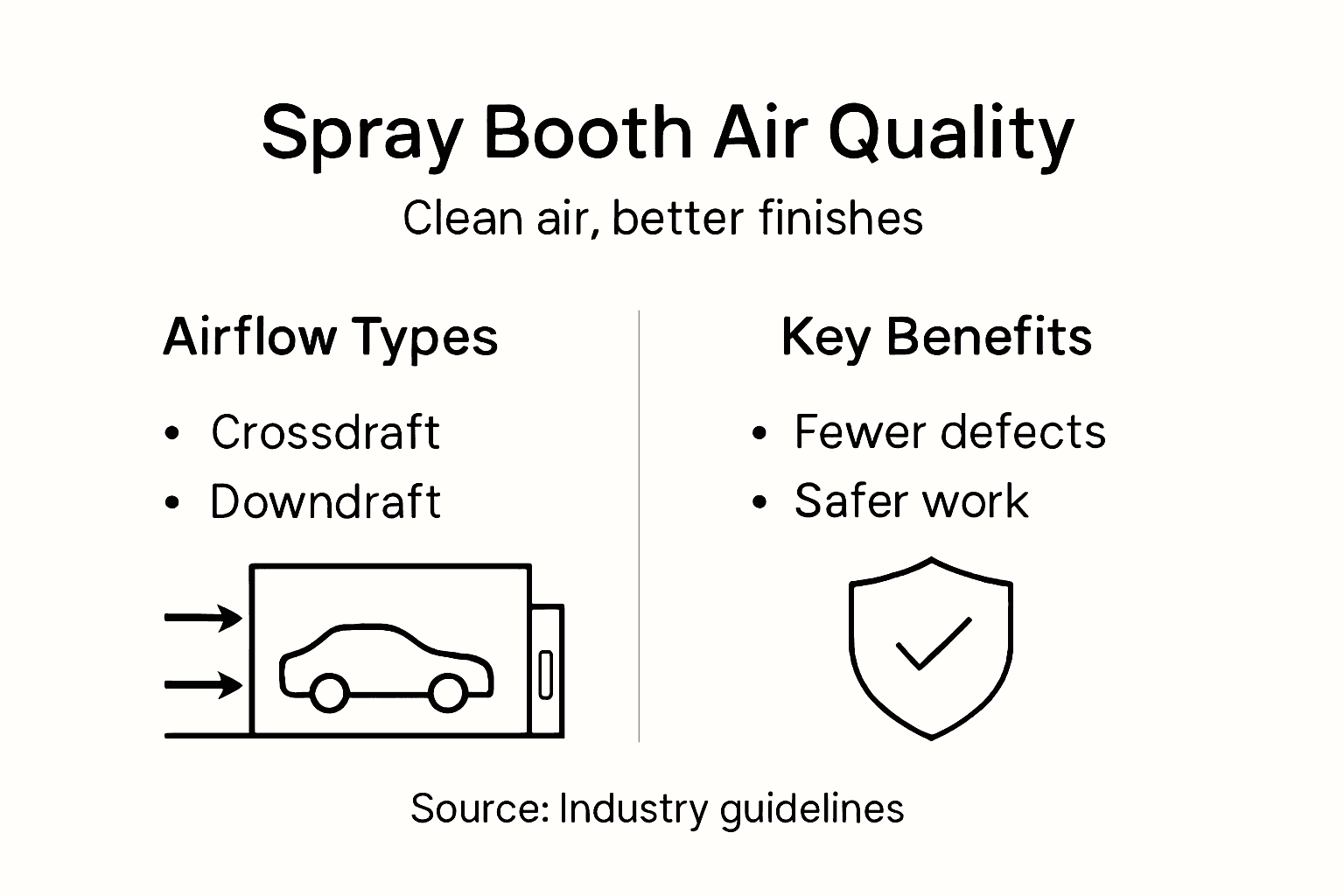
- Downdraft systems: Vertical airflow from ceiling to floor
- Crossdraft systems: Horizontal airflow from one side to another
- Semi-downdraft systems: Combination of vertical and horizontal airflow patterns
Each airflow system offers unique advantages and challenges. Downdraft systems provide the most comprehensive contamination control by drawing particulates downward and away from the painted surface. These systems typically require significant infrastructure investment but deliver superior finish quality.
Downdraft airflow can reduce paint defects by up to 90% compared to other ventilation configurations.
Crossdraft configurations represent the most economical option, moving air horizontally across the painting area. While cost-effective, they present higher risks of contamination and less precise particle management. Semi-downdraft systems offer a balanced approach, combining elements of both vertical and horizontal airflow to optimize performance and cost efficiency.
Here’s a quick comparison of spray booth airflow system types and their impact on painting outcomes:
| Airflow System | Finish Quality Impact | Contamination Control | Infrastructure Cost |
|---|---|---|---|
| Downdraft | Superior, consistent | Highest effectiveness | High investment required |
| Crossdraft | Acceptable, variable | Lower particle management | Lowest, cost-efficient |
| Semi-downdraft | Balanced, reliable | Moderate level | Moderate expense |
Pro tip: Select your spray booth airflow system based on specific painting requirements, budget constraints, and desired finish quality.
How contamination impacts finish quality
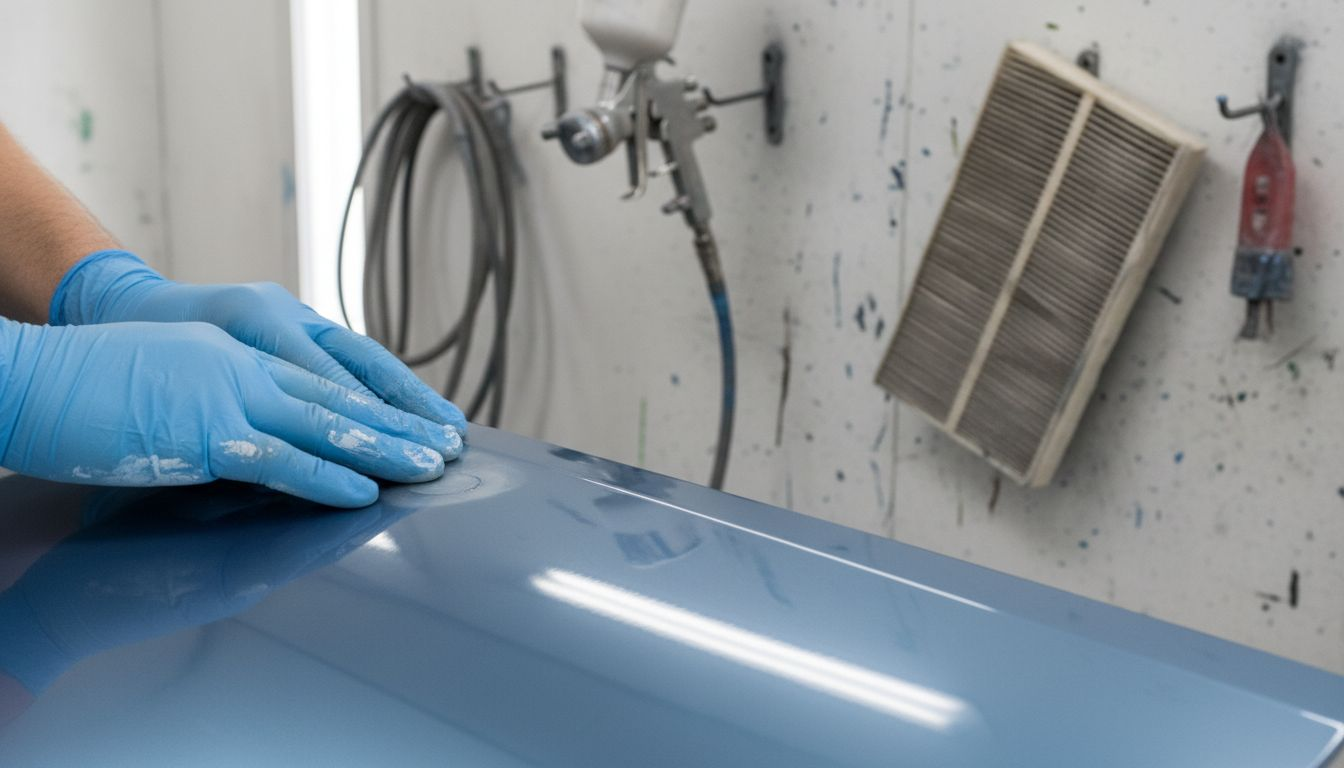
Contamination represents the most significant threat to achieving a flawless paint finish in industrial and automotive spray environments. Spray booth filter performance directly determines the level of surface imperfections and overall coating quality.
The primary sources of contamination that compromise finish quality include:
- Dust particles floating in the spray booth atmosphere
- Overspray recirculation from inadequate ventilation
- Airborne debris from surrounding work environments
- Equipment-generated particulates from aging spray equipment
Microscopic contaminants can create numerous defects in paint application, ranging from minor surface irregularities to complete coating failure. These imperfections manifest as bumps, uneven textures, discoloration, and reduced paint adhesion. Even tiny particles measuring less than 10 microns can compromise the entire painting process.
Uncontrolled contamination can reduce paint finish quality by up to 65% and increase rework costs significantly.
The impact of contamination extends beyond aesthetic concerns, potentially creating structural vulnerabilities in the coating. Trapped particles prevent proper paint adhesion, leading to premature coating breakdown, reduced durability, and increased maintenance requirements for painted surfaces.
Pro tip: Implement daily cleaning protocols and use high-efficiency particulate air filters to minimize contamination risks in your spray booth.
Air filtration and dust control technologies
Advanced air filtration represents the cornerstone of maintaining superior spray booth performance and finish quality. Spray booth filtration technologies have evolved dramatically to address increasingly complex contamination challenges in industrial painting environments.
The primary filtration technologies used in modern spray booths include:
- Dry filtration systems using fiberglass and pleated paper media
- Multi-stage paint arrestor filters capturing microscopic particulates
- Electrostatic precipitation technologies for advanced particle removal
- HEPA filtration for ultra-fine dust and contaminant elimination
Intake and exhaust filtration work together to create a comprehensive dust control strategy. Intake filters prevent external contaminants from entering the spray environment, while exhaust filters capture overspray and airborne particles generated during painting operations. Advanced systems can remove particles as small as 0.3 microns, ensuring an exceptionally clean painting atmosphere.
Advanced filtration technologies can reduce surface contamination by up to 95%, dramatically improving coating quality and consistency.
Modern dust control technologies go beyond simple particle removal, incorporating intelligent design principles that optimize airflow, minimize pressure drop, and extend filter life. Sophisticated systems now integrate real-time monitoring and predictive maintenance capabilities, allowing facilities to proactively manage their air quality performance.
Pro tip: Implement a systematic filter replacement schedule and invest in multi-stage filtration systems to maximize spray booth air quality and finish consistency.
Review key filtration technologies and their business benefits:
| Filtration Technology | Particle Size Removed | Typical Use Case | Business Benefit |
|---|---|---|---|
| Dry filtration | Larger debris (>5 microns) | Basic dust control | Reduces maintenance needs |
| Multi-stage paint arrestor | Microscopic particles (<1 micron) | Advanced finish quality | Minimizes rework and defects |
| HEPA filtration | Ultra-fine dust (0.3 microns) | High-precision environments | Maximizes coating durability |
| Electrostatic precipitation | Variety of particle sizes | High-volume operations | Efficient energy utilization |
Health, safety, and compliance obligations
Spray booth operations demand rigorous adherence to complex health and safety regulations that protect workers and ensure operational integrity. Spray finishing safety standards establish comprehensive guidelines for managing potential workplace hazards in industrial painting environments.
Key regulatory compliance requirements include:
- Personal protective equipment (PPE) specifications
- Ventilation system design standards
- Hazardous material handling protocols
- Emergency response and fire prevention measures
- Worker training and certification requirements
Occupational exposure limits represent a critical component of safety management, focusing on controlling potentially harmful chemical and particulate exposures. Regulations mandate specific monitoring protocols, requiring facilities to implement systematic approaches for measuring and mitigating workplace health risks associated with spray painting operations.
Comprehensive safety compliance can reduce workplace incidents by up to 78% and minimize potential legal and financial liabilities.
Federal and state regulations impose strict requirements on spray booth design, maintenance, and operational practices. These standards address multiple dimensions of worker safety, including respiratory protection, fire prevention, chemical exposure management, and environmental contamination control. Facilities must maintain detailed documentation demonstrating ongoing compliance with these multifaceted regulatory frameworks.
Pro tip: Conduct quarterly comprehensive safety audits and maintain meticulous documentation to ensure continuous regulatory compliance and worker protection.
Avoiding costly mistakes in spray booth air management
Ineffective air management can transform a precision painting operation into a financial nightmare, causing significant operational losses and quality degradation. Air flow management strategies are critical for preventing expensive mistakes that compromise finish quality and workplace safety.
Common costly air management errors include:
- Neglecting filter maintenance leading to reduced airflow efficiency
- Improper airflow configuration causing contamination and uneven coating
- Insufficient pressure differential resulting in dust infiltration
- Overlooking regular air quality monitoring
- Inadequate worker training on booth environmental controls
Pressure monitoring represents a crucial yet frequently overlooked aspect of preventing expensive operational failures. Sophisticated digital manometers can provide real-time insights into filter performance, allowing proactive interventions before catastrophic system failures occur. Operators who understand and implement strategic air management protocols can dramatically reduce rework and material waste.
Implementing comprehensive air management strategies can reduce operational costs by up to 40% and minimize finish quality defects.
Each spray booth configuration presents unique airflow challenges that demand tailored management approaches. Sophisticated facilities integrate advanced sensor technologies, predictive maintenance protocols, and systematic training programs to create robust, reliable painting environments that minimize costly errors and maximize operational efficiency.
Pro tip: Develop a comprehensive air management checklist and conduct monthly performance audits to identify and mitigate potential system vulnerabilities.
Elevate Your Spray Booth Air Quality with Proven Dust Protection Solutions
The article highlights the crucial role of clean air and contamination control in achieving flawless paint finishes and operational efficiency in spray booths. Common challenges like microscopic dust infiltration, overspray, and inadequate filtration demand effective strategies to prevent costly defects and maintain superior quality. Your goal is to reduce paint finish imperfections and protect sensitive surfaces from airborne particles that threaten adhesion and durability.
Dust Free Film specializes in solving these exact problems by offering premium dust protection films designed specifically for spray booths used in automotive refinishing and industrial painting. Our innovative multi-layer electrostatic wall and floor protectors create a reliable barrier that minimizes contamination risks and supports the advanced air filtration concepts discussed in the article. These films are static-free, heat-resistant, and manufactured to European standards, making them ideal for high-traffic industrial environments seeking to optimize airflow and pressure control.
Explore Dust Free Film solutions today and discover how our patented application systems deliver quick, bubble-free installation that fits perfectly with your spray booth ventilation strategy.

Don’t let dust and airborne debris reduce your coating quality or increase costly rework. Take action now to secure your spray booth’s finish integrity with trusted dust control technology. Visit Dust Free Film and harness advanced dust protection solutions tailored for your operational needs.
Frequently Asked Questions
What is the importance of air quality in spray booths?
Maintaining optimal air quality in spray booths is essential for achieving high finish quality, ensuring worker safety, and optimizing operational efficiency. Proper ventilation and filtration help control contamination, reduce paint defects, and improve overall painting performance.
How does airflow velocity affect spray booth performance?
Airflow velocity plays a crucial role in controlling particle movement within the spray booth. It helps prevent the accumulation of contaminants and ensures that paint particles are properly contained, which is vital for achieving a flawless finish.
What types of airflow systems are used in spray booths?
The primary types of airflow systems in spray booths include downdraft systems (vertical airflow from ceiling to floor), crossdraft systems (horizontal airflow from one side to another), and semi-downdraft systems (a combination of both). Each system has its advantages and challenges regarding contamination control and finish quality.
How can I minimize contamination risks in my spray booth?
To minimize contamination risks, implement daily cleaning protocols, regularly monitor air quality, and use high-efficiency particulate air filters. Additionally, ensure proper ventilation design and conduct routine filter replacements to maintain optimal airflow and reduce defects.