

Dust control in spray booths does one thing above everything else: it keeps contamination off fresh paint. Uncontrolled particulate causes finish defects, drives up rework rates, accelerates equipment wear, and puts your facility on the wrong side of OSHA, NFPA, and EPA expectations. Three things you can act on right now:
- Add multi-layer, static-free protective films to booth walls and ceilings as a source-capture layer
- Integrate film coverage into your booth airflow and filter replacement schedule
- Set measurable KPIs: particulate counts, paint defect rate per 1,000 units, and rework labor hours
Dustfreefilm’s multi-layer electrostatic booth protectors and patented dispenser system are a practical, procurement-ready solution that addresses all three.
Table of Contents
- Why does dust control matter beyond basic housekeeping?
- How airborne particulate actually ruins a paint finish
- Where do protective films fit in a layered dust-control strategy?
- What film specifications should you require in procurement?
- How should you install and maintain booth films?
- What are your OSHA, NFPA, and EPA obligations?
- How do you measure ROI on dust-control films?
- Why Dustfreefilm is a practical choice for spray-booth facilities
- Key Takeaways
- What most facilities get wrong about dust control
- Get product information and samples from Dustfreefilm
- Useful sources for compliance and technical reference
Why does dust control matter beyond basic housekeeping?
Uncontrolled dust in manufacturing plants is an operational threat, not a cleanliness issue. Airborne particles settle into wet paint, clog spray equipment, and contaminate freshly prepared surfaces before a technician can apply a topcoat. The result is a predictable chain: more defects, more rework, more wasted material, and longer booth cycle times.
The machinery side is just as costly. Dust accelerates wear on bearings, motors, and filtration media. Clogged filters reduce airflow, which disrupts the positive-pressure environment a spray booth depends on. When airflow drops, contamination risk rises and booth performance degrades faster than most maintenance schedules anticipate.
Effective dust management in factories also carries a safety dimension that housekeeping alone cannot address. Combustible dust accumulations on surfaces and in ductwork create explosion and fire hazards. OSHA’s combustible dust enforcement program, NFPA 652 and 654 guidance on dust hazard analysis, and EPA fugitive dust best practices all frame dust control as a compliance obligation, not an optional upgrade.
The importance of dust control becomes clearest when you price a single rework cycle: labor, materials, booth time, and the downstream scheduling disruption. Multiply that by a realistic monthly defect rate and the investment case for a layered dust-control program writes itself.
How airborne particulate actually ruins a paint finish
Airborne particulate is the primary source of finish defects in spray booths, and most of it is invisible until it is already in the paint. The failure chain runs like this: particles become airborne from sanding, surface prep, or HVAC entrainment, travel through the booth atmosphere, and settle onto wet film within seconds of application.
Four mechanisms drive contamination:
- Particle settling: Gravity pulls fine dust onto horizontal and near-horizontal surfaces, including freshly sprayed panels
- Electrostatic attraction: Charged particles migrate to grounded metal surfaces and to the paint film itself, embedding before the coat flashes off
- HVAC entrainment: Inadequately filtered makeup air carries particles directly into the spray zone
- Top-down contamination: Dust on lights, rafters, and upper wall surfaces dislodges during booth operation and falls into the wet coat
The defect types map directly to particle size and source. Fish-eyes and craters typically trace to silicone or oil contamination. Dust nibs come from fiber and skin particles. Orange peel and pitting often result from larger debris dislodged from high surfaces. Identifying the defect type tells you where in the booth the contamination originated, which is the fastest path to a targeted fix.
Where do protective films fit in a layered dust-control strategy?
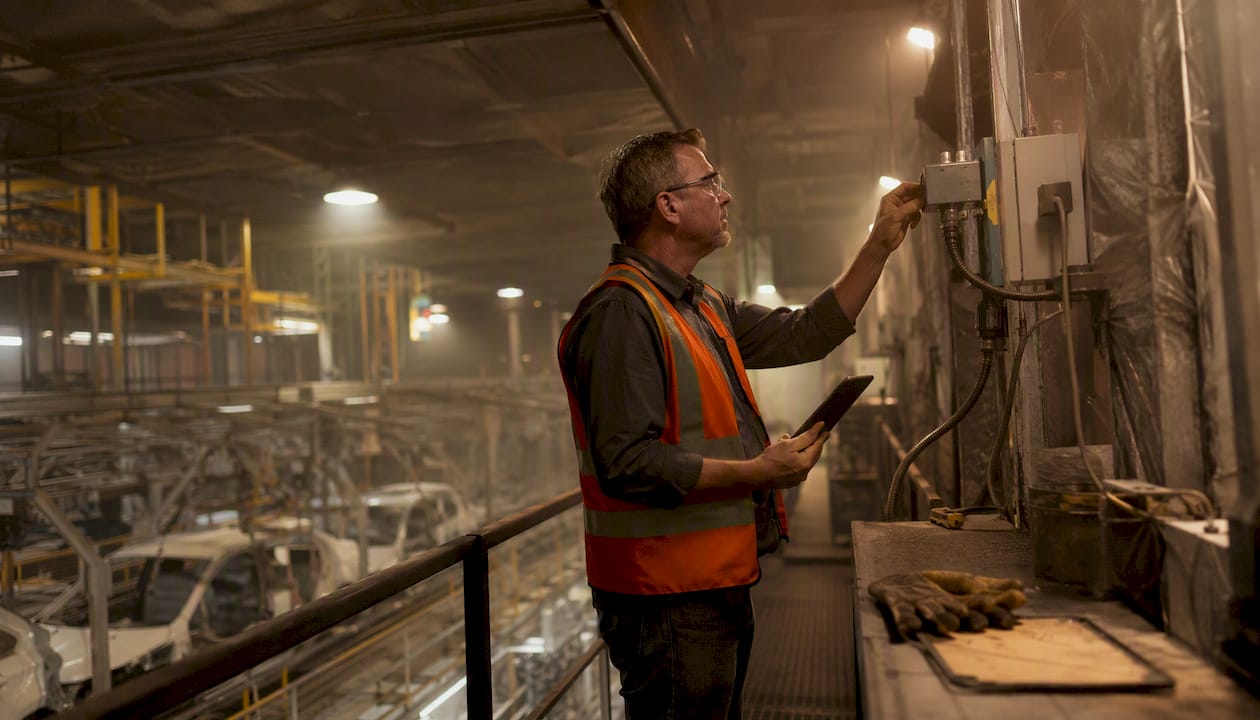
Films are a source-capture and containment layer. They do not replace ventilation, filtration, or housekeeping; they make all three more effective by trapping particles at the surface before they become airborne again. Integrated dust control systems that combine targeted protections with proper airflow design consistently outperform single-measure approaches.
A complete spray-booth dust-control program typically includes:
- Booth airflow design: Positive pressure, downdraft or crossdraft configuration, and adequate air changes per hour
- HEPA or box filtration: Inlet and exhaust filters rated for the particle sizes your process generates
- Routine cleaning protocols: Scheduled wipe-downs, vacuuming with HEPA-equipped equipment, and surface prep discipline
- Adhesive and masking practices: Proper masking prevents overspray migration and reduces debris generation
- Protective films: Wall, ceiling, and floor protectors that capture settled dust and prevent re-entrainment
Compared to relying solely on increased filtration or manual cleaning, films offer a clear operational advantage in high-throughput environments. Filters require scheduled replacement and cannot capture dust that has already settled on booth surfaces. Manual cleaning takes booth time and introduces its own contamination risk. Films, by contrast, peel away with the contamination already attached. Prioritize films when turnaround time is short, rework cost is high, or your facility runs multiple shifts with limited cleaning windows between jobs.
What film specifications should you require in procurement?
Require heat resistance, a static-dissipative surface, multi-layer construction, dispenser compatibility, and clean-removal adhesive performance. Those five criteria separate a film that works in a spray booth from one that creates new problems.
A procurement-ready spec checklist:
- Temperature rating: Minimum 140°F (60°C) continuous; verify compatibility with your booth’s bake cycle if applicable
- Static-safety designation: Static-dissipative or anti-static surface treatment to prevent particle attraction
- Thickness and tear strength: Sufficient gauge to survive installation and removal without tearing mid-peel
- Adhesive peel and residue behavior: Clean removal with no adhesive transfer to booth surfaces after full cure exposure
- Roll length and width: Sized to cover wall-to-ceiling runs without mid-surface seams where possible
- Dispenser compatibility: Patented or purpose-built dispenser that allows single-person, tape-free installation
- Custom sizing options: Availability of non-standard widths for irregular booth geometries
- Bulk purchasing: Volume pricing for facilities running multiple booths or high replacement frequency
Operationally, single-person installation matters more than most buyers realize. A film that requires two people to hang without bubbles adds labor cost on every booth changeover. Confirm that the supplier’s dispenser system handles wall-to-ceiling runs without a second set of hands.
Pro Tip: Ask suppliers to provide installation time per 100 square feet and a written clean-removal guarantee. Both belong in your RFP as acceptance criteria, not as verbal assurances.
How should you install and maintain booth films?
A repeatable install-and-replace cycle is what separates facilities with consistently clean finishes from those that treat film as a one-time setup. Build it into your shift routines and booth turnaround plans from day one.
Installation steps:
- Clean and dry all booth surfaces before film application; any residue under the film will telegraph through to the surface and compromise adhesion
- Load the film roll into the dispenser system and confirm the leading edge is square to the wall
- Start at the ceiling-wall junction and work downward, maintaining light tension to prevent bubbles
- Overlap seams by at least two inches; never leave a gap between film sections at corners or joints
- Trim excess at floor level with a straight edge, not freehand, to keep edges clean and prevent lifting
- Inspect the full surface for bubbles or lifted edges before the booth goes back into service
Maintenance schedule:
- Visually inspect film at every booth changeover for soiling, tears, or lifted edges
- Replace when visible contamination reaches the point where particles could re-enter the air stream, or after any bake cycle that exceeds the film’s rated temperature
- Document replacement dates and disposal method; some film materials qualify for standard industrial recycling streams
- Check high surfaces (lights, upper walls) at every inspection; top-down contamination from missed areas is the most common reason films underperform
For best practices in dust prevention, integrate film replacement into the same checklist as filter inspection so neither gets skipped under production pressure.
What are your OSHA, NFPA, and EPA obligations?
Dust-control measures in U.S. spray booths support obligations under three overlapping regulatory frameworks. Understanding which applies to your operation helps you justify capital spend and document compliance.
- OSHA: Combustible dust enforcement focuses on hazard recognition, housekeeping, and ignition-source control. Spray booths handling flammable coatings also fall under 29 CFR 1910.94 (ventilation) and relevant NFPA standards adopted by reference
- NFPA 652/654: Requires a Dust Hazard Analysis (DHA) for facilities where combustible dust is present; the DHA determines whether your dust-control program meets the standard
- EPA fugitive dust guidance: Frames dust control as a compliance investment that prevents material loss and reduces environmental liability
- Documentation: Maintain ventilation inspection records, filter replacement logs, housekeeping schedules, and film replacement dates; these are the records an inspector will request first
The role of dust control in industrial safety extends beyond finish quality. A documented, layered program is your evidence that the facility takes combustible-dust and worker-exposure risks seriously.
How do you measure ROI on dust-control films?
Track four numbers: particulate counts, paint defect rate, rework cost per defect, and cleaning labor hours. Together they give you a before-and-after picture that justifies the spend.
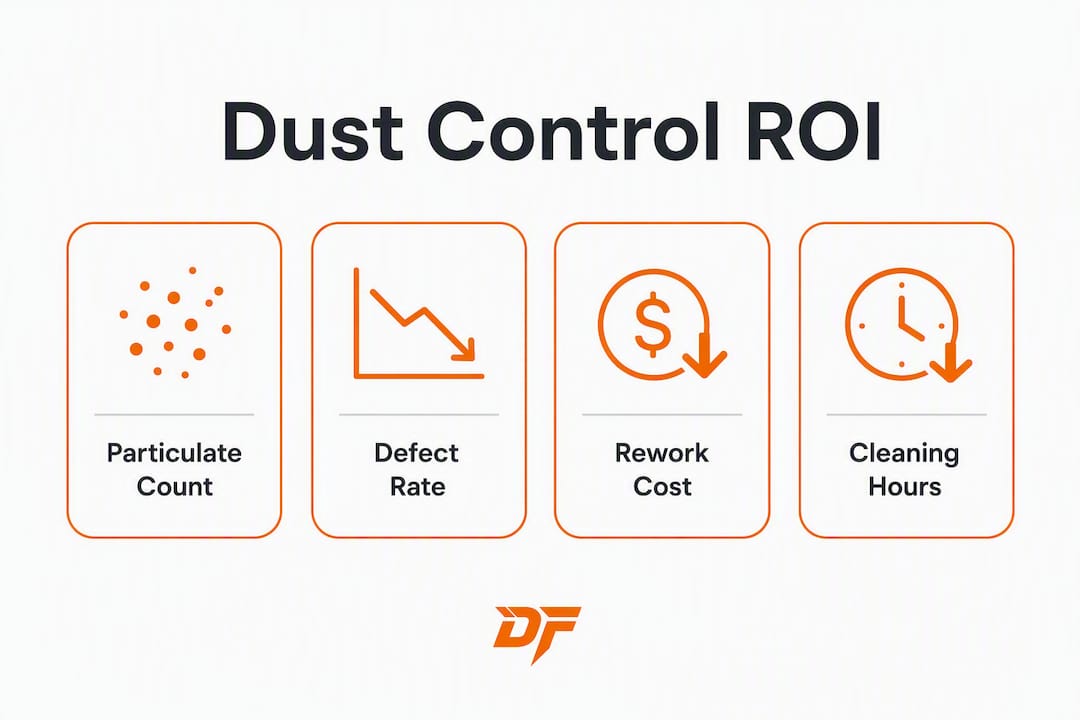
| KPI | Baseline (pre-film) | Post-install | Delta |
|---|---|---|---|
| Particulate count (particles/m³) | Measure at booth center | Re-measure same point | Target reduction |
| Paint defect rate (per 1,000 units) | Record average | Record post-install | % improvement |
| Rework cost per defect ($) | Labor + materials + booth time | Same method | $ saved per defect |
| Cleaning labor hours (per week) | Log actual hours | Log post-install hours | Hours saved |
| Estimated annual savings ($) | — | (Delta rework cost × annual defects) + (labor hours saved × hourly rate) | Total annual ROI |
A simple example: if your facility averages multiple rework events per month with labor and materials costs adding up significantly, the annual rework cost can be substantial. Even a moderate reduction from better dust containment can save thousands annually, often more than the annual cost of film and dispenser consumables across multiple booths.
Why Dustfreefilm is a practical choice for spray-booth facilities
Dustfreefilm’s multi-layer electrostatic booth protectors and patented dispenser system address the two biggest friction points in film-based dust control: installation speed and surface coverage. Since 2012, the company has focused exclusively on spray-booth environments in automotive refinishing, industrial painting, and manufacturing applications.
Key product features to include in your specs when evaluating Dustfreefilm:
- Multi-layer construction for extended service life between replacements
- Static-dissipative surface that reduces particle attraction and manual wiping frequency
- Heat resistance suitable for bake-cycle environments
- Patented dispenser system enabling single-person, tape-free wall-to-ceiling installation
- Custom sizing for non-standard booth geometries
- Bulk purchasing options for multi-booth facilities and high-volume operations
The strongest fit is high-throughput auto refinish shops and industrial painting lines where booth turnaround time directly affects revenue. Facilities running two or more shifts with limited cleaning windows between jobs see the clearest operational return. For dust-free finishes in spray booths, Dustfreefilm’s field experience across automotive and industrial accounts since 2012 translates directly into product specifications that match real booth conditions.
Key Takeaways
Dust control in spray booths is an operational KPI, not a housekeeping task. Facilities that treat it as a measurable, layered program consistently achieve lower defect rates and faster booth turnaround.
| Point | Details |
|---|---|
| Films are a containment layer | Protective films work alongside ventilation and filtration, not instead of them. |
| Top specs to require | Heat resistance, static-dissipative surface, multi-layer construction, and dispenser compatibility are non-negotiable procurement criteria. |
| ROI is measurable | Track defect rate, rework cost, and labor hours before and after installation to quantify savings. |
| Compliance supports spend | OSHA, NFPA 652/654, and EPA fugitive dust guidance all support a documented, layered dust-control program. |
| Dustfreefilm | Multi-layer, static-free booth protectors with a patented dispenser system, available for automotive and industrial facilities since 2012. |
What most facilities get wrong about dust control
Dust control fails when it is treated as a setup task rather than a continuous operational discipline. The most common mistake is installing films once, then leaving them in place until a quality complaint forces a change. By that point, contamination has already cycled through multiple jobs.
The second most common pitfall is ignoring high surfaces. Lights, rafters, and upper wall sections accumulate dust that falls directly into wet paint. Wall-to-ceiling film coverage is not optional in a high-throughput booth; it is the difference between a controlled environment and one that looks controlled until the first bake cycle dislodges debris from an uncovered rafter.
Static-safe products are also underspecified more often than they should be. A film without a static-dissipative surface actively attracts particles, which defeats the purpose. Dustfreefilm has been solving exactly these problems for facilities since 2012, and the pattern holds: the facilities with the lowest rework rates are the ones that treat film replacement as a scheduled event, not a reaction to a bad job.
Get product information and samples from Dustfreefilm
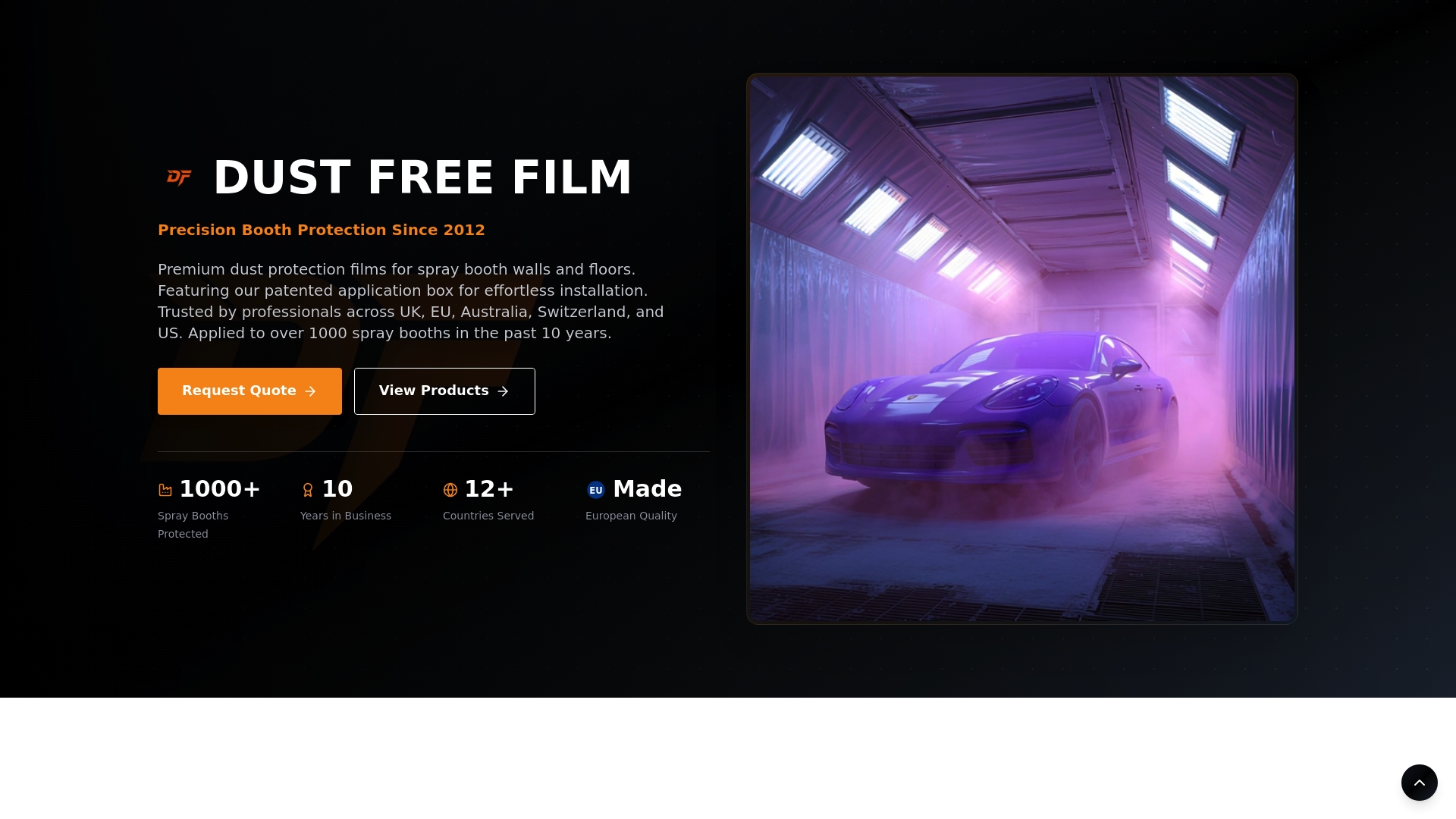
Fewer rework cycles and faster booth turnaround start with the right film specification. Dustfreefilm supplies multi-layer, static-free booth protectors and patented dispenser systems direct to automotive and industrial facilities across the United States, with custom sizing and bulk pricing available for multi-booth operations.
Practical next steps for procurement:
- Request a sample roll to verify adhesive performance and clean-removal behavior on your booth surface
- Ask for a dispenser demo to confirm single-person installation time against your current changeover schedule
- Request a custom size quote if your booth geometry requires non-standard film widths
- Download product specification sheets for inclusion in your RFP or purchase order documentation
Contact Dustfreefilm directly at dustfreefilm.com to request samples, pricing, or a quote for your facility. For facilities evaluating complementary process-optimization services, ION Precision Products also offers industrial finishing support worth reviewing alongside your dust-control program.
Useful sources for compliance and technical reference
Start with primary sources when building your compliance documentation.
- EPA Fugitive Dust Control Best Practices: Covers environmental compliance obligations and strategic investment framing for dust-control programs
- NFPA 652 and NFPA 654: Combustible dust fundamentals and industry-specific guidance; governs Dust Hazard Analysis requirements for spray-booth facilities
- OSHA 29 CFR 1910.94: Ventilation requirements for spray-finishing operations; the baseline standard for booth design and airflow documentation
- Dust control strategies for manufacturing plants: Industry assessment of operational and compliance risks from uncontrolled dust
- Dustfreefilm blog resources: Practical guidance on ambient dust control, booth-specific implementation, and facility manager checklists