

Dust contamination is the silent killer of paint quality in spray booths, causing visible defects that demand costly reworks and frustrated customers. Every particle that settles on wet paint creates imperfections that compromise your finish and reputation. This guide walks you through proven maintenance protocols, airflow optimization, humidification strategies, and filtration techniques that eliminate dust at its source. You’ll learn exactly how to transform your spray booth into a controlled environment that delivers consistently superior results.
Table of Contents
- Understanding The Dust Problem In Spray Booths
- Preparing Your Spray Booth: Maintenance And Filtration Essentials
- Executing Dust Reduction With Airflow And Humidification Strategies
- Verifying Dust Control Effectiveness And Troubleshooting Common Issues
- Protect Your Spray Booth With Dust Free Film
- FAQ About Reducing Dust In Spray Booths
Key takeaways
| Point | Details |
|---|---|
| Regular maintenance cuts defects | Facilities with strict cleaning schedules see 15-20% fewer paint defects from dust contamination. |
| Humidification captures airborne particles | High-pressure systems reduce floating dust while cooling the workspace for operator comfort. |
| Airflow optimization prevents accumulation | Treating ventilation as a precision instrument ensures particles exit rather than settle on surfaces. |
| Filter selection impacts performance | Choosing filters based on booth type and paint chemistry maintains consistent air quality. |
| Verification sustains results | Pressure monitoring and visual inspections catch problems before they compromise finishes. |
Understanding the dust problem in spray booths
Dust infiltrates spray booths from multiple sources that operators often overlook. Construction materials shed particles continuously. Every time you walk across the floor, fibers lift into the air. Incoming ventilation air carries contaminants from outside. Even the painting process itself generates overspray particles that circulate and settle.
These particles create immediate, visible problems on wet paint surfaces. Nibs, craters, and orange peel textures force you to sand and repaint entire panels. Facilities with strict maintenance saw 15-20% decrease in paint defects due to dust control. The financial impact extends beyond materials to labor hours and delayed delivery schedules.
Controlling dust requires understanding where it originates and how it moves through your booth. Three primary sources demand attention:
- Structural contamination from booth walls, floors, and fixtures that continuously shed particles
- Operator activity including clothing fibers, foot traffic, and equipment movement
- Supply air that introduces external contaminants despite filtration systems
Addressing these sources starts with maintaining clean spray booths through systematic protocols. Without foundational cleanliness, even advanced filtration and airflow systems struggle to deliver acceptable results. Your booth environment must be treated as a precision workspace where every surface and system contributes to or detracts from paint quality.
Preparing your spray booth: maintenance and filtration essentials
Systematic preparation creates the foundation for dust-free painting. Start with a maintenance schedule that addresses every contamination source before paint application begins. Weekly cleaning removes accumulated particles from walls, floors, and equipment. Monthly inspections identify wear points where dust generation increases. Quarterly filter replacements maintain consistent airflow and particle capture.
Your cleaning workflow should follow this sequence:
- Remove all portable equipment and mask materials from the booth
- Vacuum walls from top to bottom using HEPA-filtered equipment
- Wet mop floors with tack cloths to capture remaining particles
- Wipe down light fixtures, door frames, and ventilation grilles
- Inspect and clean exhaust plenums where particles accumulate
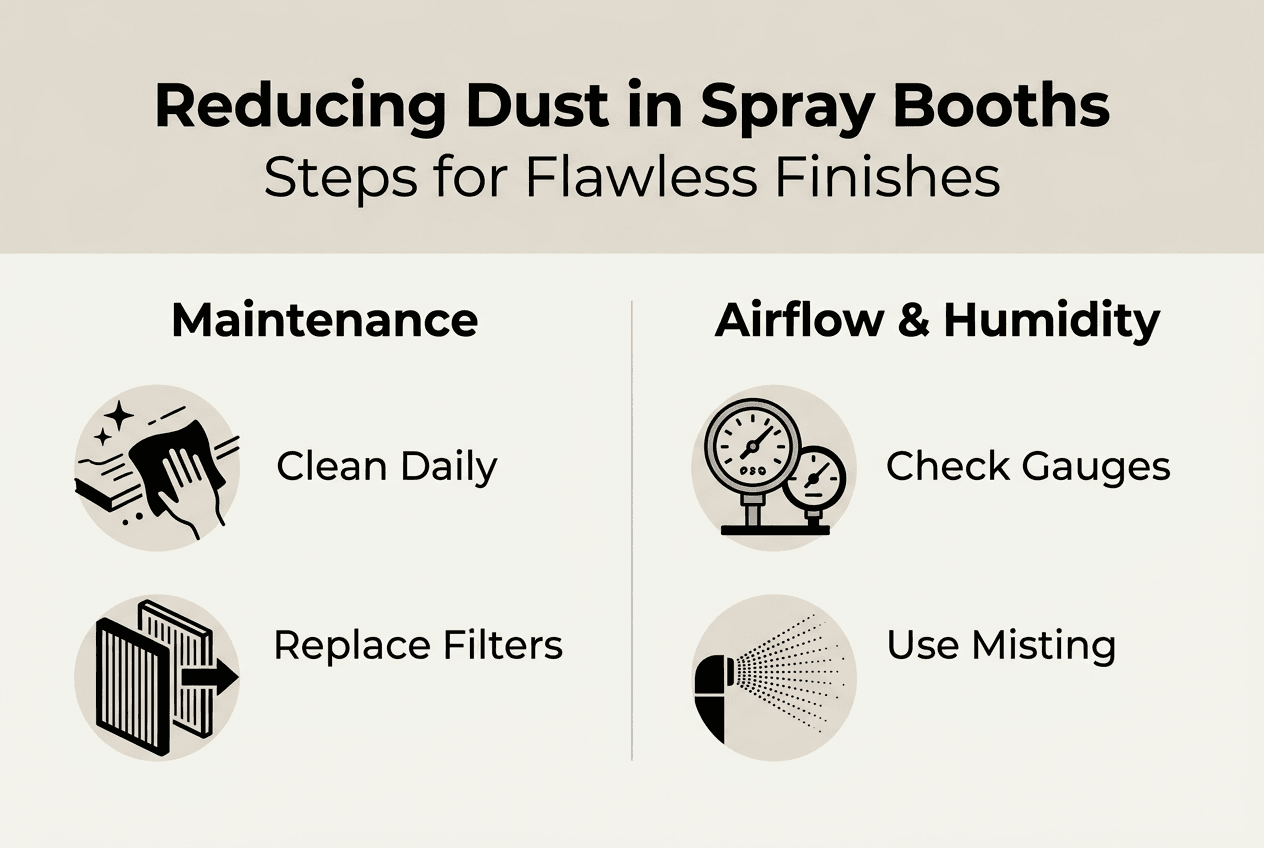
Regular maintenance including cleaning and filter replacement is essential for optimal dust control. The benefits of spray booth maintenance extend beyond dust reduction to energy efficiency and equipment longevity.
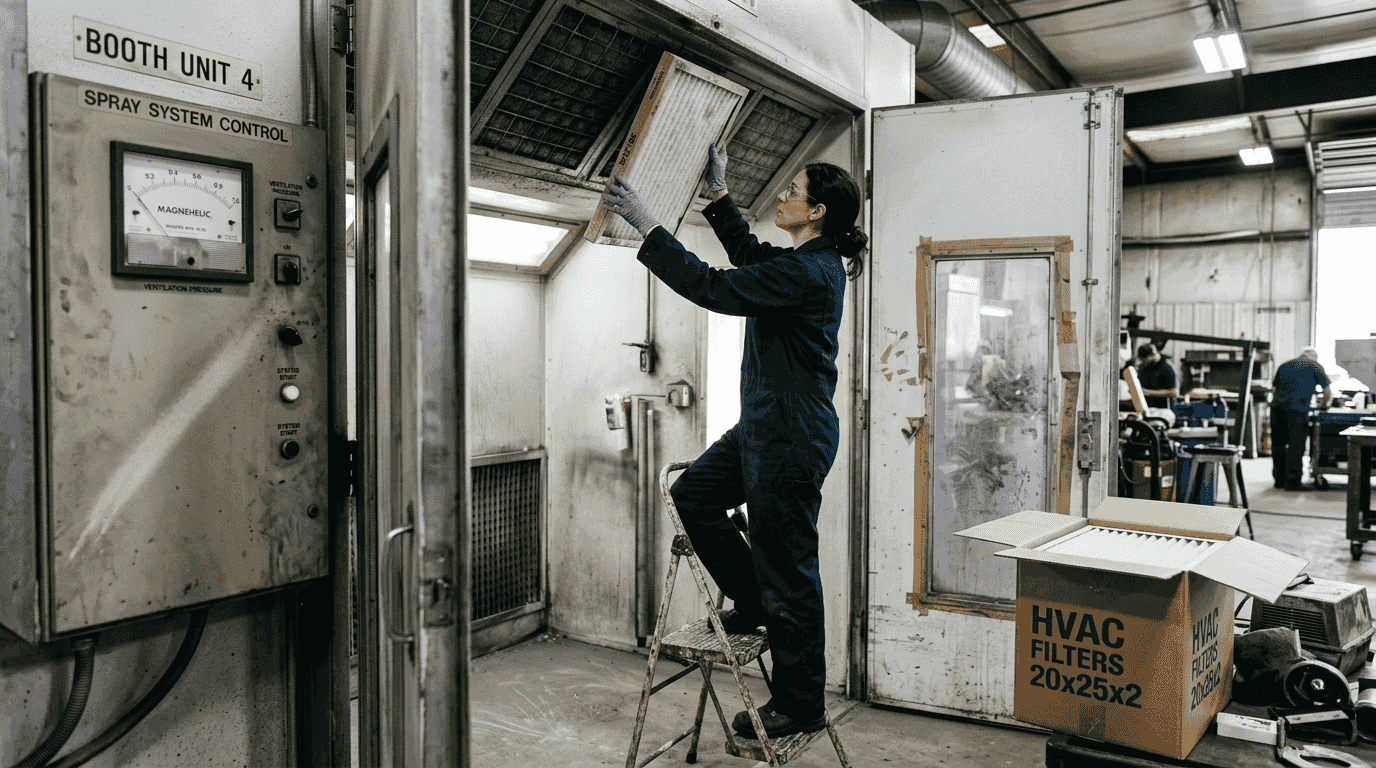
Filter selection directly impacts your booth’s particle capture capability. Match filter specifications to your specific application:
| Booth Type | Recommended Filter | Replacement Frequency |
|---|---|---|
| Automotive refinishing | MERV 13-14 intake, 2-stage exhaust | 3-4 months intake, monthly exhaust |
| Industrial coatings | MERV 15-16 intake, multi-pocket exhaust | 2-3 months intake, bi-weekly exhaust |
| High-volume production | HEPA intake, continuous roll exhaust | Monthly intake, weekly exhaust |
Pro Tip: Monitor airflow gauges to spot pressure drops indicating need for filter replacement. A 20% pressure increase signals reduced efficiency that compromises dust capture.
Establish a maintenance checklist that operators complete before each painting session. This workflow ensures consistency across shifts and prevents oversight. Document filter changes, pressure readings, and cleaning activities to identify patterns and optimize your schedule. The paint booth filter guide provides detailed specifications for various booth configurations.
Your preparation phase must also address operator practices. Require lint-free coveralls and head coverings that minimize fiber shedding. Implement sticky mats at booth entrances to capture floor debris before it enters the painting area. These simple protocols compound with equipment maintenance to create a truly controlled environment.
Executing dust reduction with airflow and humidification strategies
Optimizing airflow transforms your booth from a simple enclosure into a precision instrument for particle control. Proper airflow in automotive paint booths requires treating ventilation as an active dust removal system rather than passive circulation. Air movement patterns determine whether particles exit through exhaust or settle on painted surfaces.
Downdraft booths naturally excel at dust removal when properly balanced. Supply air enters through ceiling filters at consistent velocity, sweeps downward across the work surface, and exits through floor grates. This vertical flow pattern carries particles away from the paint zone continuously. Crossdraft configurations require more attention to prevent dead zones where particles accumulate.
Achieve optimal airflow by:
- Balancing supply and exhaust volumes to maintain slight negative pressure
- Positioning work pieces to avoid blocking air paths
- Eliminating obstructions that create turbulence and particle recirculation
- Maintaining consistent booth temperature to prevent thermal currents
Optimizing spray booth airflow delivers measurable improvements in finish quality. Operators report fewer defects and reduced touch-up requirements when airflow receives the same attention as paint mixing and application technique.
Humidification systems add another dimension to dust control by capturing airborne particles before they reach painted surfaces. High-pressure humidification systems reduce airborne dust and improve finish quality through water droplet interaction with floating contaminants. Particles bind to moisture and drop from the air column rather than remaining suspended.
Two humidification approaches serve different booth layouts:
| System Type | Best For | Key Advantage | Maintenance Need |
|---|---|---|---|
| Direct room | Open spray areas, large booths | Even distribution, immediate effect | Weekly nozzle cleaning |
| Duct integration | Enclosed booths, controlled zones | Precise humidity control | Monthly system flush |
Direct room systems spray fine mist into the booth atmosphere, creating immediate particle capture throughout the space. Duct integration introduces humidity through supply air, offering precise control but requiring more complex installation. Your choice depends on booth size, layout, and existing ventilation configuration.
Pro Tip: Humidification provides adiabatic cooling that improves operator comfort without energy-intensive air conditioning. The evaporative effect can reduce booth temperature by 10-15 degrees while simultaneously controlling dust.
Maintain humidification systems rigorously to prevent mold and bacteria growth. Use filtered water, clean nozzles weekly, and flush lines monthly. These practices ensure the system remains a dust control asset rather than becoming a contamination source. The spray booth humidification case study demonstrates implementation results in high-volume automotive facilities.
Verifying dust control effectiveness and troubleshooting common issues
Verification protocols confirm your dust control measures deliver expected results. Systematic monitoring catches degradation before it impacts paint quality. Start with daily visual inspections that identify obvious problems. Check filter surfaces for loading, examine booth surfaces for particle accumulation, and review finished work for defect patterns.
Pressure monitoring provides objective performance data:
- Record baseline pressure readings when filters are new
- Measure supply and exhaust pressures before each painting session
- Compare current readings to baseline values
- Schedule filter replacement when pressure increases 20% or more
- Document all readings to identify seasonal patterns and optimize schedules
Common dust control issues reveal themselves through specific symptoms. Filter clogging reduces airflow velocity, allowing particles to settle rather than exit. Inadequate humidification leaves dust suspended in dry air where it eventually lands on wet paint. Airflow imbalance creates dead zones where particles accumulate despite ventilation.
Address these problems with targeted corrections:
- Clogged filters: Replace immediately and investigate why loading occurred faster than expected
- Dry air conditions: Increase humidification output or check nozzle function
- Dead zones: Reposition supply diffusers or add supplemental fans to improve circulation
- Persistent contamination: Inspect booth structure for deteriorating materials that shed particles
Pro Tip: Maintaining humidification systems for air quality prevents mold and bacteria growth that can introduce new contamination sources. Regular maintenance is essential to keep these systems beneficial rather than problematic.
Implement scheduled checks that operators complete consistently. Morning verification before painting starts catches overnight changes. Mid-shift reviews during high-production periods ensure systems maintain performance under load. End-of-day inspections prepare the booth for the next session and identify maintenance needs.
Document your results to track improvement over time. Record defect rates, rework hours, and customer complaints related to finish quality. Compare these metrics before and after implementing dust control measures. Quantifiable improvements justify continued investment in maintenance and system upgrades. The paint booth cleaning guide provides detailed protocols for maintaining verification standards.
Your verification process should also include periodic deep inspections. Quarterly reviews examine hidden areas where dust accumulates unnoticed. Check exhaust plenums, filter housing seals, and ventilation ductwork for particle buildup. These thorough examinations prevent gradual degradation that erodes paint quality over months.
Protect your spray booth with Dust Free Film
While maintenance and airflow optimization control airborne dust, protecting booth surfaces prevents particle generation at its source. Dust Free Film products provide durable wall and floor protection that complements your dust control protocols. The multi-layer electrostatic films capture particles before they become airborne, reducing contamination from booth structure itself.

These protective films install quickly using patented dispenser systems that eliminate bubbles and ensure complete surface coverage. Heat-resistant and static-free construction maintains performance in high-temperature spray environments. Replace films on your maintenance schedule to continuously refresh booth surfaces without extensive cleaning downtime. Request a Dust Free Film quote to explore custom configurations for your facility’s specific needs.
FAQ about reducing dust in spray booths
How often should spray booth filters be replaced for optimal dust control?
Replace intake filters every 3-4 months for automotive refinishing and 2-3 months for industrial coatings. Exhaust filters require more frequent changes, typically monthly for automotive applications and bi-weekly for high-volume production. Monitor pressure gauges rather than relying solely on calendar schedules, as usage patterns affect filter life significantly.
What are the differences between direct room and duct humidification systems?
Direct room systems spray mist into the booth atmosphere for immediate particle capture and even distribution throughout open spaces. Duct integration introduces humidity through supply air, offering precise control and better performance in enclosed booths. Direct systems require weekly nozzle cleaning while duct systems need monthly flushing to prevent buildup.
Can humidification systems cause mold if not maintained properly?
Yes, inadequate maintenance allows mold and bacteria growth in water lines, nozzles, and collection areas. Use filtered water, clean nozzles weekly, and flush complete systems monthly to prevent biological contamination. Regular maintenance keeps humidification systems beneficial for dust control rather than introducing new contamination sources.
How does airflow affect dust accumulation in spray booths?
Optimized airflow sweeps particles away from painted surfaces and directs them toward exhaust filters continuously. Poor airflow creates dead zones where particles settle and turbulence that recirculates contaminants. Balanced supply and exhaust volumes with slight negative pressure prevent dust from escaping while ensuring particles exit rather than accumulate on surfaces.
Why is regular booth cleaning critical even with advanced dust control systems?
Filters and airflow manage airborne particles but cannot address dust already settled on surfaces. Weekly cleaning removes accumulated contamination before it becomes airborne again during painting. Booth structures continuously shed particles from wear and deterioration, requiring physical removal that ventilation systems alone cannot achieve. Cleaning and filtration work together to maintain dust-free environments.